Dog Head?
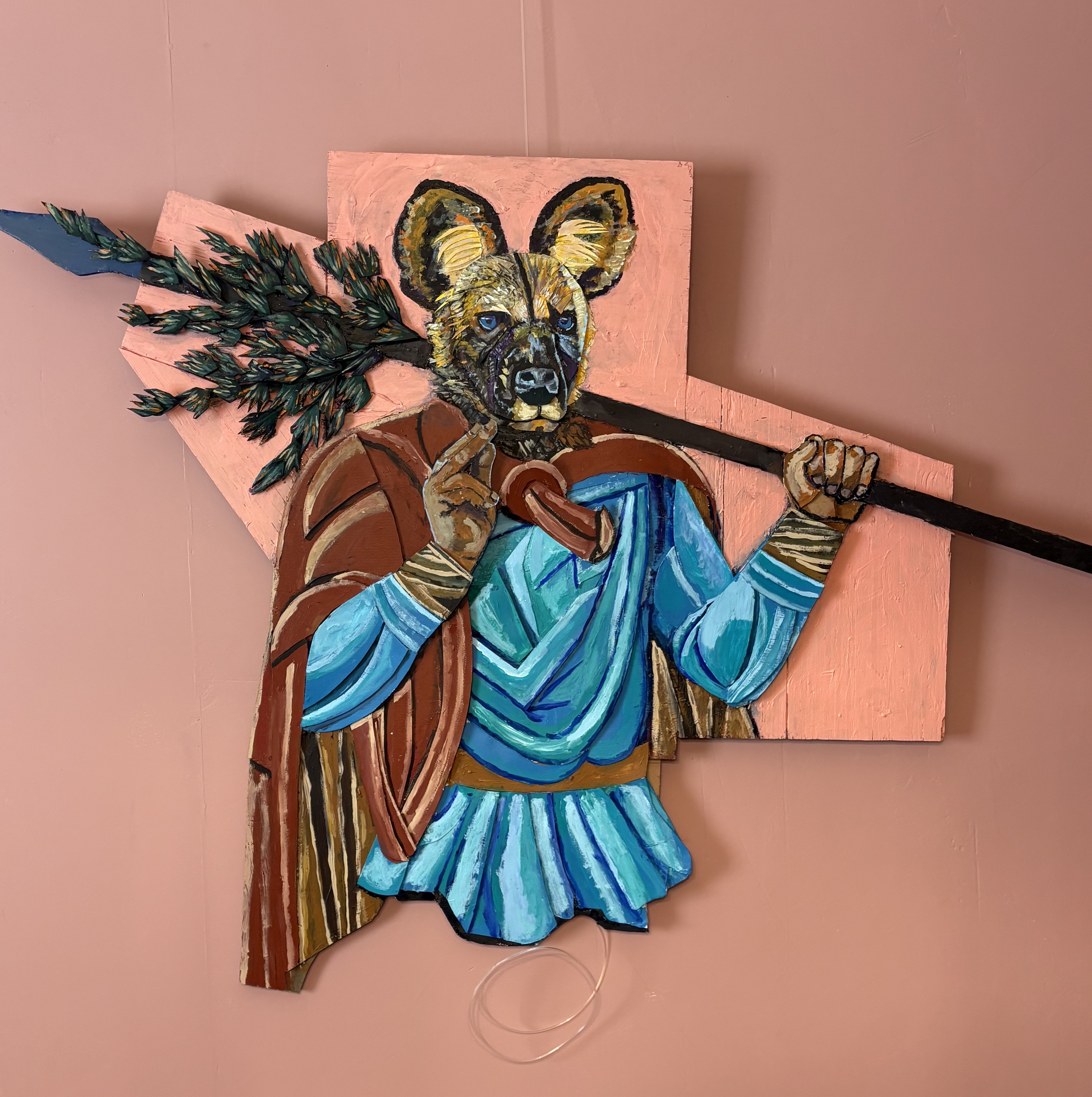
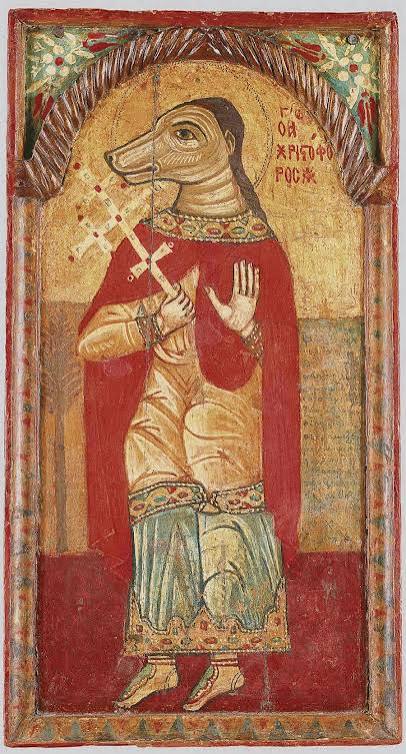
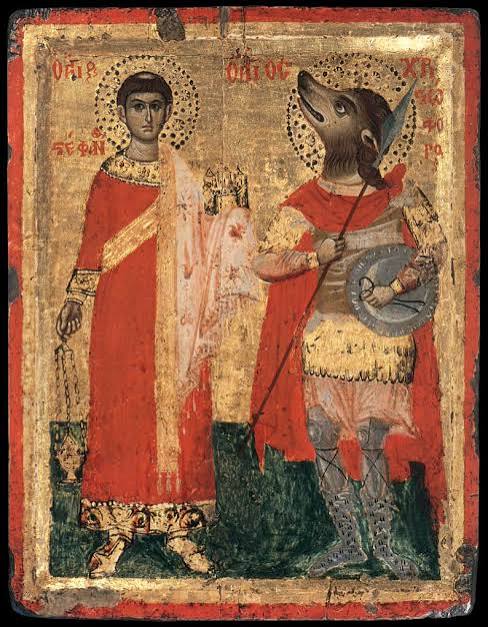
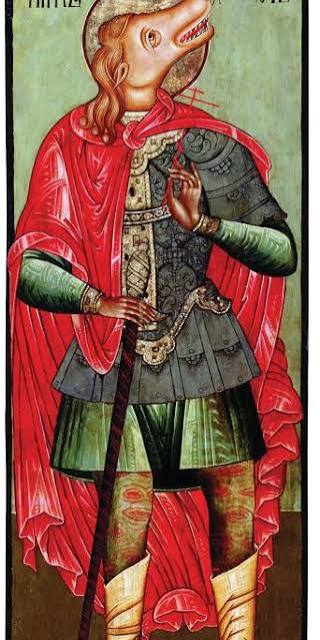
This painting is very close to my heart. It’s from a tradition of painting St. Christopher with a Dog’s Head. It’s a really interesting tributary of Christian tradition that intersects with both myth and truth in a weird way. Here’s a thought about where it comes from, but no one really knows for sure why this happened or why it’s continued: https://orthodoxartsjournal.org/the-icon-of-st-christopher/
I think the reason it’s persisted is that it visually represents the truth of who St. Christopher is supposed to be. Cards on the table, I don’t think St. Christopher the actual person is historically verifiable. I think, though, he is such a powerful Christian archetype that you could look at any era or any location of Christianity and find him. A dangerous, lawbreaking man who becomes a gentle saint is one of the deepest journeys of the faith. I’ve met that person two, three, maybe more times. The dog head, the wolf head, and in my take the wild dog head, communicate a danger that poignantly offsets the clothes and pious stance of the figure. It embodies in an image the whole dynamic of the person.
Fairy Chess:
I haven’t figured out how to do this, but I consistently circle back to Fairy Chess Pieces when I think about a next painting to try: (https://en.wikipedia.org/wiki/Fairy_chess_piece) With his icon being proscribed by Vatican II and the squeamishness from every institutional quarter with him being painted with a dog head, I think of him as a Fairy Chess piece of the saints.
As a protestant, I enjoy saints differently than the Catholics and Orthodox do. I see many of them as encouraging historical examples (of course), I enjoy the icons as good art and teaching, and most importantly I think of them as mythical symbols of the Christian life. This last one deserves unpacking, and I’m hoping to flesh it out with many of my future paintings. The Bible is incredible, and it’s the book the church needs. Importantly, though, it doesn’t get updated as history unfolds. There’s not new Bible DLC or patches to help you do 14th century plague, war, and famine. How do you exist as a Christian in different eras?
I think of the Saints as a repository of Christian wisdom in answering those questions. I think they embody a deposit of Christian imagination, even the ones that were historic. How we draw, think about, and pass down narratives about the lives of the saints is a reflection of how the church uses imagination to communicate artisticly. Even with real people, biography works as creative organization and expression. It’s like how a non symbolic map would have to cover the literal earth-even something pegged to reality has to figure out rules of editing and expression. Much more the saints, who are constructed from passed down tradition, rival iconographic depictions, and connected to supernatural experiences. With St. Christopher this is even more pronounced, as his existence is disputed and his icon involves a canine head often. I think that the Fairy Chess pieces of Christian canonization offer a vital imaginary that can be accessed by Christians for deep inspiration into how to live. This is what Christian heroism looks like, painted in fantastic proportions for ready access into the romance of being a gentle person. People were so attached to this image that it survived censure and bans and attempts to flush it away.
There is a romance to the saints, a romance that has the same valence as Greek or Arthurian romance, that offers an alternative vision of adventure. I think that this is one of the most profound impacts of Christian art through the ages. Christian art seems to work best when it’s saying something positive that is organically rooted within a deeply formed social Christian imagination. Instead of the shallow water toddler splash fights with secular society that we are used to today, the icon tradition as art expansively captures a vital, powerful energy partially transcendent to immediate context.
Wild Dogs
I picked an African Spotted Dog for this because I wanted to capture a range of feelings. First, dogs just aren’t the same as they used to be; having him be a dog doesn’t create the dynamic tension I was hoping for. Second, the furries are all over the internet now, and using a husky or wolf is affected by the gravitational pull of big plush wearing adults. Third, I wanted something located in Africa. St. Christopher was allegedly North African, and Wild Dogs are sub Saharan, but I think that there is a cool energy by making that connection.
Ultimately, it’s unexpected and shocking in just the right way. They feel dangerous and strange. I was hoping the final product would have the effect of feeling arrestin and otherworldly.
I made it, like usual, with cut up paper, cedar wood shingles, acrylic paint, my jigsaw, and plumber’s glue. I hope you enjoy it.


I really like this. And I didn’t know about this particular tradition of depicting St. Christopher. As always I appreciate your thoughtful approach to your work.